
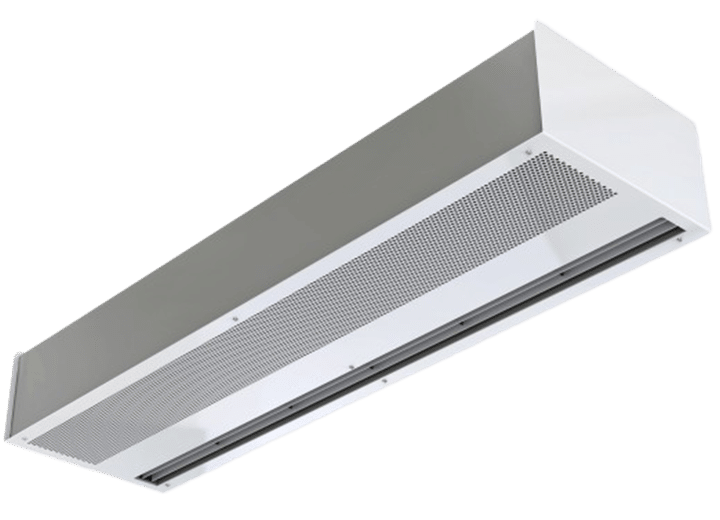
Every time a commercial entrance door opens, warm air escapes and cold air pushes in.
Air curtains solve that by maintaining an invisible barrier of air across the opening, keeping the indoor environment stable without requiring the door to stay closed.
For buildings with high footfall, the energy saving over a full year is significant.
With access to the full range from fully recessed architectural units through to heavy-duty industrial curtains, the CEG advises on the right product for the application, the heat source, and the building’s specification requirements.
To discuss your project or request a quote, call our team on 0141 212 3388 or fill in our online enquiry form.
How Air Curtains Work
An air curtain projects a controlled stream of air downward across a doorway or opening, creating a pressure differential that separates the indoor environment from the outside.
Cold air, insects, dust, and pollutants are kept out while conditioned air stays in.
The barrier is invisible and does not restrict access in the way a physical door would.
Units are mounted above the entrance and discharge air at a velocity matched to the width and height of the opening.
We work closely with you to understand the door dimensions, temperature requirements, and whether the application calls for a heated unit or a neutral ambient barrier.
The right unit arrives on site the first time.
Minimise heat loss with CEG. Reach out to our team today for high quality, energy efficient solutions.

Air Curtains for Every Entrance Type
Air curtain selection starts with the entrance.
The type of door, the scale of the opening, and the finish requirements all determine which product fits the project.
We start with what the air curtain needs to cover, then work through the heat source, mounting position, and aesthetic requirements to find the correct unit for the application.
Recessed Air Curtains
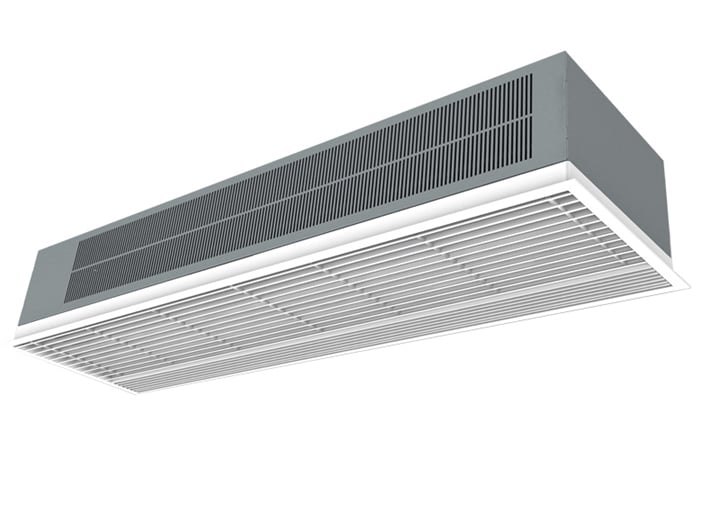
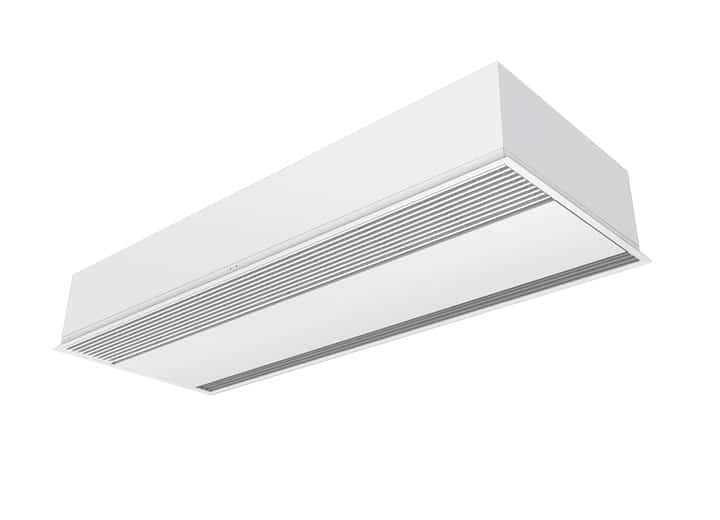
Fully recessed units sit concealed above the entrance, discharging air through a discreet slot in the ceiling or lintel.
The airflow is active, but the unit is invisible.
Our range covers electric, LPHW, and ambient configurations.
Custom sizes are available to suit any opening, making recessed units a great choice for high-end commercial entrances, hotels, and architectural spaces where finish matters.
Exposed Air Curtains
A reliable and cost-effective solution for most commercial entrances, our exposed overdoor and wall-mounted range is a great solution.
Electric and water-heated options are available in standard and bespoke finishes across a wide range of door widths and building types.
Revolving and Rotating Door Air Curtains
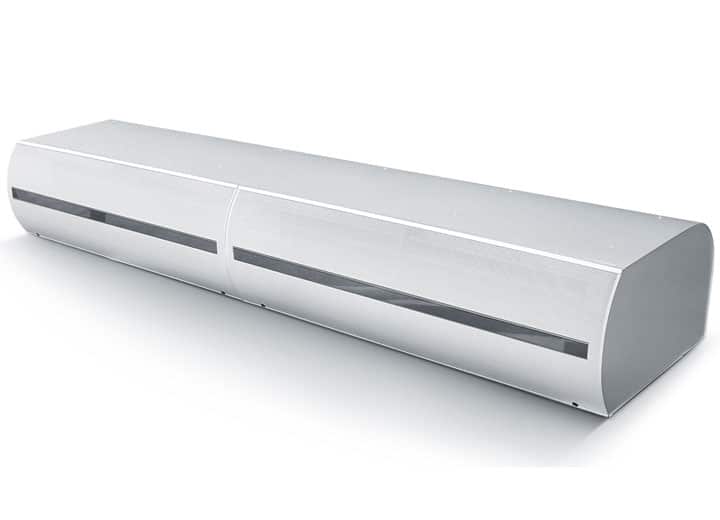
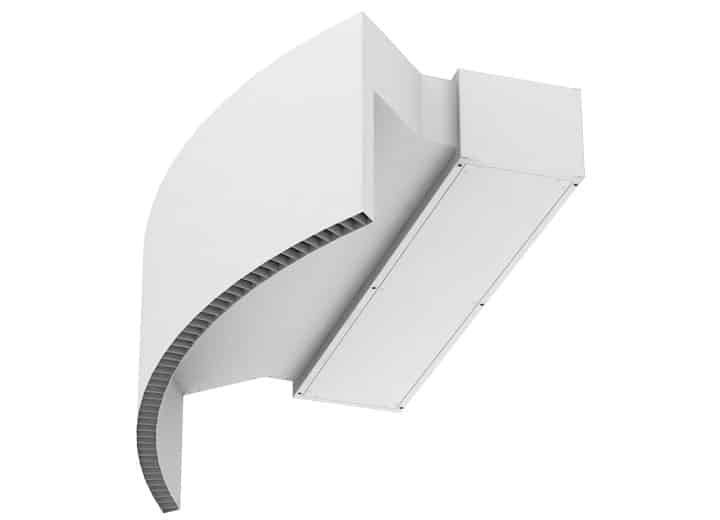
Ideal for hotels, civic buildings, and landmark entrances where the door itself is a design feature, revolving door air curtains use curved and circular configurations that wrap around the door geometry.
We arrange bespoke engineered solutions to suit the exact dimensions and design requirements of each entrance.
Maintain the thermal barrier across an opening that is rarely fully closed with CEG.
Industrial Air Curtains
Our industrial range covers high-performance units for large warehouse openings, loading bays, and factory doors.
Standard products often cannot meet the scale or the conditions these environments demand.
Both horizontal and vertical mounting options are available. Each unit is selected to operate reliably wherever it is installed.
Three Technical Heating Configurations
Air curtains are available in three heating configurations.
The right choice depends on what heat source is available in the building and how much additional heating the entrance requires.
Our team will advise on which heater option suits your project from the outset.
Electric Air Curtains
Electric air curtains generate heat from an internal element, requiring no connection to the building’s hot water system.
They suit entrances where pipework is not available or where a self-contained installation is preferred.
We help select the correct output for the door width and location, so performance is not compromised.
LPHW Air Curtains
LPHW air curtains connect to the building’s low pressure hot water system, drawing heat from the same boiler or heat pump that serves the rest of the building.
For larger entrances with higher heat loss, this is usually the stronger specification.
Our team works with the building services engineer to match the unit output to the system.
Ambient Air Curtains
Ambient units discharge air at the surrounding temperature without adding heat. This creates a pressure barrier that keeps cold air, insects, and dust out.
In climate-controlled environments where the temperature at the entrance is already managed, ambient is often the correct call.
We will tell you honestly if this is a smart choice for your project.
Controls and BMS Integration
An air curtain that runs at full power when footfall is low wastes energy. One that activates when a door opens and stands down when it closes has more energy efficiency.
The control system is as important as the unit, and we factor it in from the start.
Remote and Smart Controls
Remote and programmable controls let building managers adjust fan speed, temperature setpoints, and time scheduling without access to the unit itself.
For multi-entrance buildings, centralised control keeps management straightforward.
We discuss control requirements at the outset so the system we recommend is right for your project and premises.
Door Sensors and Automation
Door sensors trigger the air curtain the moment an entrance opens, removing the lag between the door moving and the barrier activating.
For entrances with variable footfall, automation keeps the unit running efficiently without manual switching throughout the day.
We advise on sensor placement and compatibility during the product selection stage. The activation works correctly for the entrance type.
BMS Integration
Where a building management system is in place, air curtains can be configured to respond to building-wide conditions rather than operating on a fixed schedule.
Output adjusts in line with the heating and ventilation strategy already in place.
Our team works alongside the building services engineer and controls contractor to make sure the air curtain specification fits within the wider BMS scope.
Why Trust CEG to Supply Air Curtains
Air curtains look simple.
Mount a unit above the door, discharge air across the opening, and the barrier holds.
In practice, the specification involves door dimensions, discharge velocity, heat output, mounting position, and heat source compatibility.
All of those need to align for the unit to perform as intended. Our experience across air curtain specifications is what makes that process reliable.
Quality Advice Straight from the Beginning
Air curtains are never selected in isolation.
Door width, opening height, heat source, and whether the unit needs to be recessed or surface-mounted all feed into the recommendation.
This ensures the right unit arrives on site first time.

Combined 100 Years of Experience
With over 100 years of combined industry experience across the team, we have worked through the full range of air curtain applications.
From straightforward commercial entrances to complex architectural specifications, we adapt to you.
Returning clients come back because the technical support on their second project matches what they received on their first.

Suppliers That Know Their Clients and Products
No two entrances are the same, and we do not treat them as if they are.
At the Old Course Hotel in St Andrews, we specified overdoor units across two separate locations within the same building, each requiring a different solution.
Different entrance configurations called for different products.
Supplying the same unit across both would have meant one performing below expectation, and that is not an outcome we accept.

Constructionline Certified
CEG are Constructionline Certified.
We support procurement compliance for public sector frameworks and main contractor supply chains across Scotland and the UK.
Common Questions of Air Curtains
What is the difference between electric or ambient air curtains?
Electric air curtains use an integrated heating element to discharge warm air across the entrance. Ambient units discharge air at room temperature and suit applications where draught exclusion is the primary requirement rather than heat retention. LPHW units connect to the building’s existing heating system and are common on larger retail and commercial projects.
Have you supplied air curtains for large commercial projects in Scotland?
Yes, including city-centre regeneration schemes in Scotland covering front and rear entrances across multiple stores and restaurants. We manage the full system design, unit selection, and coordinated supply across the programme, working directly with contractors throughout.
Do air curtains connect to a building management system?
Yes. The units we supply support BMS integration, allowing airflow and operating schedules to be controlled centrally alongside other ventilation equipment. Sensors activate the unit when a door opens and shut it down when the entrance is unoccupied.
Contact Us Today for Guidance in the Air Curtain Sector
Whether you need an overdoor unit for a standard commercial entrance or a fully recessed curtain for a high-end architectural space, our team can help.
When you get in touch, you’ll hear back quickly from someone who knows the products.
If the specification shifts or the budget tightens, we work through the options with you. We’re with you from the first conversation through to delivery.
Our team works directly with contractors, consultants, and architects across Scotland and the UK. If your project calls for more than air curtains, we can help with that too.
From trench heating and fan coil units to grilles, louvres and diffusers, we have what you need for an energy-efficient premises.
Call us today on 0141 212 3388 or fill in our online enquiry form to discuss your project and request a quote.