
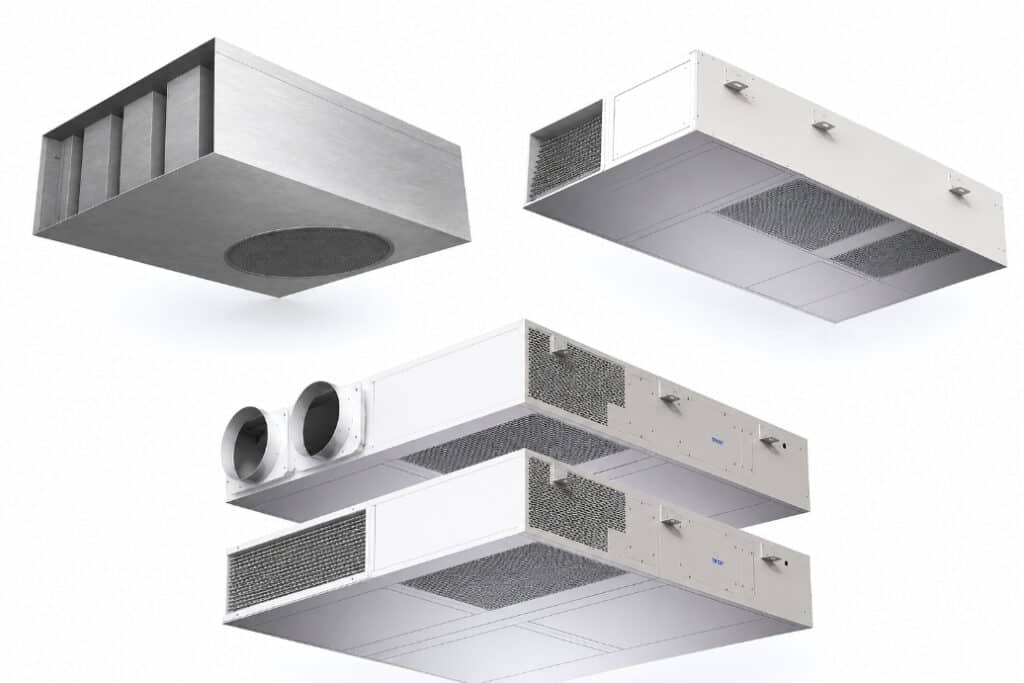
Dampers, attenuators, and mixing boxes form the in-duct control layer of any commercial ventilation system, and getting the specification right on these components matters as much as the air handling unit selection.
CEG are a supply specialist.
We communicate reliably with site contractors throughout the procurement process and recommend products based on what the project requires, alongside valuable insights on design considerations around each component.
Whether the project calls for standard off-the-shelf configurations or bespoke components fabricated to order, we manage the supply chain from first enquiry through to site delivery. We provide the technical documentation your team needs to install and commission correctly.
To discuss your ventilation requirements or request a quote, call our team on 0141 212 3388 or by filling out our online enquiry form.
What Are Ventilation Products and Accessories?
Ventilation products and accessories cover a broad range.
Fans and air handling units move and condition air. Dampers, attenuators, and mixing boxes control airflow within the ductwork. Grilles, louvres, and diffusers sit at the point where air enters or leaves the occupied space.
Where ductwork passes through external walls or fire compartment boundaries, these in-duct components determine how well the system performs and whether it meets the required standards.
The ventilation components on this page sit in the middle layer of a ventilation system, working alongside heat recovery systems and air handling units to manage airflow, acoustic performance, fire protection, and indoor air quality at the duct level.
Without correct specification of these ventilation products, the wider system cannot perform as designed and optimal air quality across the building becomes difficult to sustain.
For a complete HVAC supply, our range also covers air handling units, fan coil units, and grilles, louvres and diffusers.

Dampers
Dampers regulate airflow within ductwork, and the type required depends on what the damper needs to do in the ventilation system.
CEG supply the full range of damper types to M&E contractors and building services consultants across Scotland and the UK.
Volume Control Dampers
Volume control dampers (VCDs) are installed within ductwork runs to regulate the volume of air passing through each section of the ventilation system.
They are the primary tool for balancing airflow across a ductwork network after the system is commissioned, and they work alongside mixing boxes and attenuators to manage the full in-duct environment.
Motorised VCDs integrate with building management systems, adjusting airflow automatically in response to occupancy, CO2 levels, or demand.
Correctly specified VCDs prevent the energy waste that results from uncontrolled air distribution, and we advise on configuration at the ventilation system design stage.
Fire Dampers
Fire dampers are installed where ductwork passes through fire-rated walls or floors at compartment boundaries.
On thermal activation, the damper closes automatically to prevent the spread of fire and hot gases through the ventilation system, maintaining the integrity of the fire compartment.
Fire damper installation is a compliance requirement across most commercial and public sector building types.
The products we supply carry the relevant fire ratings for the application, and with over 15 years of trading experience, we advise which is correct for your site.
Smoke Dampers
Smoke dampers close on activation of the building’s smoke detection system, preventing smoke migration through ventilation ductwork.
For buildings with complex smoke control requirements, we work alongside the building services engineer and fire consultant to confirm the right specification and supply products with full certification documentation.
Combination Dampers
Combine the best of both units with a combination fire and smoke damper.
Our combination damper simplifies the number of components required at each duct penetration point, reducing installation complexity in buildings where both fire and smoke control are specified.
Attenuators and Silencers
Ventilation plant generates noise that travels through ductwork into occupied spaces.
Attenuators and silencers are installed within duct runs to reduce this noise transmission before it reaches the end user.
The correct acoustic specification of the project determines which product configuration is required and how much absorption is needed.
CEG supply attenuators and silencers across the full range of acoustic performance ratings, sourced from leading manufacturers and sized to the ductwork dimensions and noise target for the space.
Our deep product knowledge allows us to provide guidance on the right configuration for the project from the outset, and we always communicate realistic lead times so your programme is not caught out by supply chain delays.
Circular Attenuators
Circular attenuators are installed within round ductwork sections.
They are available across a range of diameters, lengths, and acoustic performance ratings to suit the ductwork layout and the noise specification of the project.
Rectangular Attenuators
Rectangular and splitter attenuators are used where ductwork sections are rectangular.
Splitter configurations place sound-absorbing baffles within the duct rather than lining the walls of the section, giving higher acoustic performance across shorter lengths.
For projects with demanding acoustic specifications and constrained ductwork routes, we source attenuators with the performance rating the noise target requires. Never the format that is easiest to find.
Cross Talk Attenuators
Cross talk attenuators prevent sound from travelling between adjacent rooms through shared ductwork, fitting into the branch connections between spaces.
They are rated for the level of sound reduction required and are specified where the acoustic design sets privacy targets between occupied rooms.
Our team works with you to understand your facility’s requirements and identify the right solution.
Ducting Accessories
Flexible Ducting
Flexible ducting connects rigid ductwork sections to air handling units, fans, and air terminal devices.
It absorbs vibration and accommodates minor misalignment between rigid sections.
Flexible ducting is a standard component in most commercial ventilation installations and is regularly specified alongside the dampers and attenuators.
We supply flexible ducting across a range of diameters and specifications.
Where the project calls for flexible ducting alongside other ventilation accessories, we supply across all product types from a single point of contact.
Access Doors and Panels
Regular access is a maintenance requirement across most commercial buildings.
Correctly positioned access doors make that process straightforward for the M&E contractor.
We supply access doors across a range of sizes and configurations.
Units are available to suit both circular and rectangular ductwork sections, supplied alongside the damper and attenuator products on this page where required.
Mixing Boxes
Mixing Boxes
Mixing boxes control the proportion of fresh and recirculated air entering an AHU, working alongside volume control dampers to manage airflow and energy efficiency.
Where high recirculation is required during low-occupancy periods, the mixing box makes that control possible.
Motorised versions integrate with BMS and control systems, adjusting fresh air proportion automatically in response to CO₂ levels, occupancy data, or time scheduling.
CEG supply mixing boxes alongside the damper and attenuator products on this page. Confirming mixing box selection at the control’s specification stage avoids revisions once ductwork and control wiring is committed, and manufacture has begun.
Sectors We Supply Ventilation Systems and Products
Compliance requirements, acoustic targets, and fire safety standards all vary by sector. We take the time to understand what each application demands before recommending products.
Commercial Offices and Retail
Acoustic performance is the primary challenge in open-plan offices and customer-facing retail environments. Ventilation plant noise reaches occupied spaces through ductwork, and attenuators are consistently specified on these projects to meet the noise targets in the ventilation design.
Volume control dampers allow the system to be balanced after commissioning, keeping energy use in check across the building’s operating life.
For commercial and retail projects across Glasgow, Edinburgh, and Scotland’s central belt, CEG supply ventilation components at the scale the project requires.
Our reach is continually expanding, so whether you are based in the UK or overseas, we aim to help.
Healthcare and Industrial Facilities
Fire and smoke damper specification in healthcare and clinical buildings is held to a higher standard than in general commercial construction.
We work with closely with building services engineer and fire consultant to confirm the specification before supply, ensuring the certification documentation is delivered.
Industrial facility and warehouse projects require ventilation products suited to heavier duty operating conditions, where air volumes, temperatures, and access arrangements differ considerably from office or retail use.
We source products to suit the specific requirements of the application rather than applying a standard specification.
Hospitality and Commercial Kitchens
Commercial kitchen extract systems carry demands that standard ventilation does not.
Odour control, condensation management, and backdraft prevention all require careful damper specification.
Where extract ductwork passes through fire compartment boundaries, fire damper selection becomes a compliance matter as well as a performance one.
Frequently Asked Questions
What is the difference between a fire damper and a smoke damper?
A fire damper closes on thermal activation to stop fire spreading through ductwork at compartment boundaries. A smoke damper closes on smoke detection to prevent smoke migration, and combination dampers perform both functions in a single unit.
What is a volume control damper used for?
Volume control dampers regulate the amount of air passing through ductwork sections, allowing airflow to be balanced across the ventilation network after commissioning. Motorised VCDs integrate with BMS to adjust airflow automatically in response to occupancy or demand.
Can you supply bespoke ventilation products to your specification?
Yes. Our manufacturer partners produce tailored solutions to order for non-standard duct dimensions, higher fire ratings, and insulated configurations where standard products do not meet the project requirements.
Manufacture Supply Support That Starts at Specification
CEG give contractors and building services consultants a single point of contact for a wide range of ventilation solutions, with consistent technical support from first enquiry through to site delivery.
We don’t just supply the products. We get involved at the design stage,
Guiding the site team through damper types, acoustic requirements, and mixing configurations at an early stage means the right products are confirmed before anything is committed to order.
Lead times vary, particularly for bespoke damper configurations and attenuators fabricated to order.
We give you a realistic timeframe at the enquiry stage, update you when supply chain conditions change, and plan procurement around your programme for a reliable and streamlined process.
Talk to the CEG Team About Your Project
Whether you are specifying dampers and attenuators for a new build ventilation system or sourcing replacement ventilation components for a refurbishment, CEG is here to help.
We work directly with M&E contractors, ventilation engineers, building services consultants, and architects across Scotland, throughout the United Kingdom, and increasingly overseas.
Our reach is expanding rapidly, and the team is reachable wherever your project is based when decisions need to be made quickly.
CEG are Constructionline Certified, making us a compliant choice for procurement teams working within public sector frameworks and main contractor supply chains across Scotland and the UK. If supplier accreditation is part of your vetting process, we provide documentation at the enquiry stage.
Contact our team in Glasgow online or by calling 0141 212 3388 to discuss your project and request a free quote.